Parts Implemented by Altay İnci
Developer Guide
This page is prepared according to developers.
Database Design
In this page includes explanations of database designs of season, standing and schedule class with their E/R diagrams.
Season Class
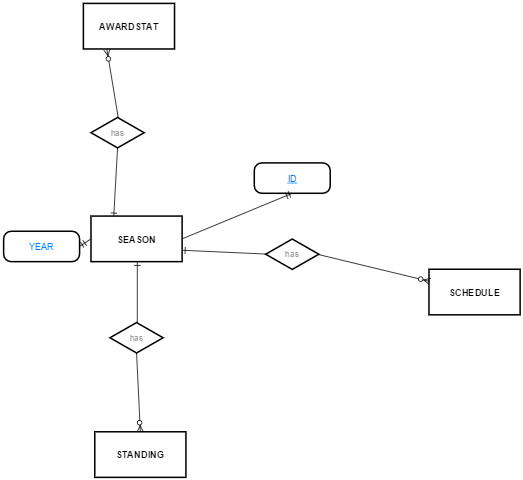
Season class has two object these are named as id which is serial PRIMARY KEY and year whose type varchar. This class does not references any object from other classes. However its year object is taken by awardstat, schedule and standing class as in its E/R diagram.
Standing Class
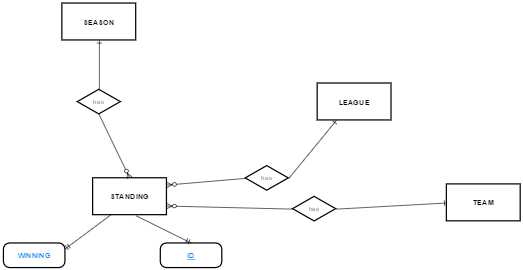
Standing class has four object these are named as id which is serial PRIMARY KEY, season_id, league_id and team_id. The last three objects’ type is integer.
This class references season_id from season class, references league_id from league class and references team_id from team class. There is no class that reference any object from this class. E/R diagram of standing class is:
- season id for years
- league id for league names
- team id for team names
Schedule Class
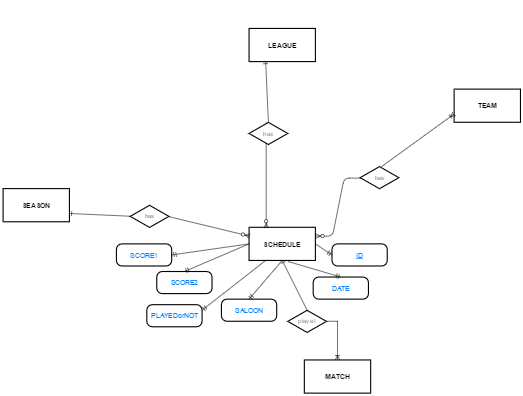
Schedule class has ten object these are named as id which is serial PRIMARY KEY, team1_id, team2_id, season_id, league_id, date, saloon, score1, score2 and state.
This class references season_id from season class, league_id from league class and references team1_id, team2_id from team class. Only match class references these class.
- season id for years (integer type)
- league id for league names (integer type)
- team1 id for team names (integer type)
- team2 id for team names (integer type)
- date (timestamp type)
- saloon (varchar type)
- score1 (integer type)
- score2 (integer type)
- state (boolean type)
Codes in Models
There are explanations of functionalities of code blocks in project
Season Class
class Season:
      def __init__(self, year, _id=None):
          self._id = _id
          self.year = year
Code in above, members of season class are initialized.
class Seasons:
    def add_season(self, season):
        query = """INSERT INTO seasons (year)
                            values (%s)"""
Code in above includes function that provides adding of a season item with SQL query.
def delete_season(self, _id):
    query = """DELETE FROM seasons WHERE id=%s"""
    self.cur.execute(query, (_id,))
    self.conn.commit()
Code in above includes function that provides deletion of a season item with SQL query.
def update_season(self, _id, new):
    query = """UPDATE seasons SET year=%s
            WHERE id=%s"""
    self.cur.execute(query, (new.year, _id))
    self.conn.commit()
Code in above includes function that provides update of a season item with SQL query.
def get_season(self,_id):
query = """SELECT * FROM seasons WHERE id=%s"""
self.cur.execute(query, (_id,))
l = self.cur.fetchone()
if l:
    ld = dict(zip(seasontable, l))
    season = Season(ld['year'], ld['id'])
    return season
else:
    return None
Code in above includes function that provides getting of a season item with SQL query.
def get_seasons(self):
    query = "SELECT * FROM seasons ORDER BY year;"
    self.cur.execute(query)
    seasons = self.cur.fetchall()
    seasonlist = []
    for l in seasons:
        ld = dict(zip(seasontable, l))
        season = Season( ld['year'],ld['id'])
        seasonlist.append(season)
    return seasonlist
Code in above includes function that provides getting and showing in screen of list of seasons item with SQL query.
def get_seasons_by(self, key, var):

skey = str(key) + '%'
query = "SELECT * FROM seasons WHERE year LIKE %s";
self.cur.execute(query, (skey,))
seasons = self.cur.fetchall()
print('seasons:', seasons)
seasonlist = []
for c in seasons:
    cd = dict(zip(seasontable, c))
    season = Season(cd['year'], cd['id'])
    seasonlist.append(season)
return seasonlist
Code in above includes function that provides searching of a season item with SQL query and a key.
Standing Class
class Standing:
    def __init__(self, season_id,league_id,team_id, season_year=None, league_name=None, team_name=None, _id=None):
        self._id = _id
        self.season_id = season_id
        self.season_year = season_year
        self.league_id = league_id
        self.league_name = league_name
        self.team_id = team_id
        self.team_name = team_name
Code in above, members of standing class are initialized.
class Standings:
    def add_standing(self, standing):
        query = """INSERT INTO standings (season_id,league_id,team_id)
                                values (%s,%s,%s)"""
Code in above includes function that provides adding of a standing item with SQL query.
def delete_standing(self, _id):
    query = """DELETE FROM standings WHERE id=%s"""
    # variables should be in tuple object
    self.cur.execute(query, (_id,))
    self.conn.commit()
Code in above includes function that provides deletion of a standing item with SQL query.
def update_standing(self, _id, new):

    query = """UPDATE standings SET season_id=%s,league_id=%s,team_id=%s WHERE id=%s"""
    self.cur.execute(query, (new.season_id,new.league_id,new.team_id, _id))
    self.conn.commit()
Code in above includes function that provides update of a standing item with SQL query.
def get_standing(self,_id):
    query = """SELECT standings.id, seasons.id, seasons.year, leagues.id, leagues.name, teams.id, teams.name
                    FROM standings,seasons,leagues,teams
                    WHERE standings.id=%s AND seasons.id=standings.season_id AND leagues.id=standings.league_id AND teams.id=standings.team_id"""

    self.cur.execute(query, (_id,))
    l = self.cur.fetchone()
    if l:
        ld = dict(zip(standingtable, l[:len(standingtable)]))
        standing = Standing(ld['season_id'], ld['league_id'], ld['team_id'], _id=ld['id'], league_name=ld['league_name'],team_name=ld['team_name'],season_year=ld['season_year'])
        return standing
    else:
        return None
Code in above includes function that provides getting of a standing item with SQL query.
def get_standings(self,limit=100, offset=0):
    query="""SELECT count(standings.id)
                        FROM standings,seasons,leagues,teams WHERE standings.season_id=seasons.id AND standings.league_id=leagues.id AND standings.team_id=teams.id
          """
        self.cur.execute(query)
        total = self.cur.fetchone()[0]

        query="""SELECT standings.id, seasons.id,seasons.year,leagues.id,leagues.name,teams.id,teams.name
                        FROM standings, seasons,leagues,teams WHERE seasons.id=standings.season_id AND leagues.id=standings.league_id AND teams.id=standings.team_id
                          LIMIT %s OFFSET %s"""
        self.cur.execute(query, (limit, offset))
        standings = self.cur.fetchall()
        standinglist = []
        for l in standings:
            ld = dict(zip(standingtable, l))
            standing = Standing(ld['season_id'], ld['league_id'], ld['team_id'], _id=ld['id'], league_name=ld['league_name'],team_name=ld['team_name'],season_year=ld['season_year'])
            standinglist.append(standing)
    return standinglist,total
Code in above includes function that provides getting and showing in screen of list of standing items with SQL query.
def get_standings_search_by(self, attrib, search_key, limit=100, offset=0):

    skey = str(search_key) + '%'

    query = """SELECT count(standings.id)
              FROM standings,leagues,teams,seasons
                    WHERE leagues.name LIKE %s AND standings.season_id=seasons.id AND standings.league_id = leagues.id AND standings.team_id = teams.id
                      """

    self.cur.execute(query, (skey,))
    total = self.cur.fetchone()[0]

    query = """SELECT standings.id, seasons.id, seasons.year, leagues.id,leagues.name, teams.id, teams.name
                    FROM standings,leagues,teams,seasons
                    WHERE leagues.name LIKE %s AND standings.season_id=seasons.id AND standings.league_id = leagues.id AND standings.team_id = teams.id LIMIT %s OFFSET %s
              """
    self.cur.execute(query, (skey,limit, offset))
    standings = self.cur.fetchall()
    print('standings:',standings)
    standinglist = []
    for l in standings:
        ld = dict(zip(standingtable, l))
        standing = Standing(ld['season_id'], ld['league_id'], ld['team_id'], _id=ld['id'], league_name=ld['league_name'],team_name=ld['team_name'],season_year=ld['season_year'])
        standinglist.append(standing)
    return standinglist, total
Code in above includes function that provides searching of a standing item with SQL query and a key.
Schedule Class
class Schedule:
    def __init__(self, team1_id, team2_id, season_id, league_id, date, saloon, score1=None, score2=None, state=False, team1_name=None,team2_name=None, season_year=None, league_name=None, _id=None):

        self._id = _id
        self.team1_id=team1_id
        self.team2_id=team2_id
        self.season_id = season_id
        self.league_id = league_id
        self.date = str(date)
        self.saloon = saloon
        self.score1 = score1
        self.score2 = score2
        self.state = state

        self.team1_name = team1_name
        self.team2_name = team2_name
        self.season_year = season_year
        self.league_name = league_name
Code in above, members of schedule class are initialized.
class Schedules:
    def __init__(self, conn, cur):
        self.conn = conn
        self.cur = cur
        self.last_key = None

    def add_schedule(self, schedule):
        query = """INSERT INTO schedules (team1_id, team2_id, season_id,league_id,date,saloon,score1,score2,state)
                                    values (%s,%s,%s,%s,%s,%s,%s,%s,%s)"""

        self.cur.execute(query, (schedule.team1_id, schedule.team2_id, schedule.season_id,schedule.league_id,schedule.date,schedule.saloon,schedule.score1,schedule.score2,schedule.state))
        self.conn.commit()
Code in above includes function that provides adding of a schedule item with SQL query.
def delete_schedule(self, _id):
    query = "DELETE FROM schedules WHERE id=%s"
    self.cur.execute(query, (_id,))
    self.conn.commit()
Code in above includes function that provides deletion of a schedule item with SQL query.
def update_schedule(self, _id, new):
    query = """UPDATE schedules SET team1_id=%s,
                        team2_id=%s,season_id=%s,league_id=%s,date=%s, saloon=%s, score1=%s,score2=%s,state=%s WHERE id=%s"""

            self.cur.execute(query, (new.team1_id, new.team2_id, new.season_id,new.league_id,new.date,new.saloon,new.score1,new.score2,new.state, _id))
            self.conn.commit()
Code in above includes function that provides update of a schedule item with SQL query.
def get_schedule(self,_id):

    query = """SELECT schedules.id, teams1.id, teams1.name, teams2.id, teams2.name, seasons.id, seasons.year, leagues.id, leagues.name, schedules.date, schedules.saloon, schedules.score1, schedules.score2,schedules.state
                    FROM seasons,leagues, schedules
                    JOIN teams teams1 ON teams1.id=schedules.team1_id
                    JOIN teams teams2 ON teams2.id=schedules.team2_id
                    WHERE schedules.id=%s AND seasons.id=schedules.season_id AND leagues.id=schedules.league_id
                    """
    self.cur.execute(query, (_id,))
    l = self.cur.fetchone()

    if l:
        ld = dict(zip(scheduletable, l[:len(scheduletable)]))
        schedule = Schedule(ld['team1_id'],ld['team2_id'],ld['season_id'], ld['league_id'], ld['date'], ld['saloon'],ld['score1'],ld['score2'], ld['state'], team1_name=ld['team1_name'], team2_name=ld['team2_name'], season_year=ld['season_year'], league_name=ld['league_name'], _id=ld['id'])
        return schedule
    else:
        return None
Code in above includes function that provides getting of a schedule item with SQL query.
def get_schedules(self, limit=100, offset=0):
        query = """SELECT count(schedules.id)
                    FROM seasons,leagues,schedules
                    JOIN teams teams1 ON teams1.id=schedules.team1_id
                    JOIN teams teams2 ON teams2.id=schedules.team2_id
                    WHERE seasons.id=schedules.season_id AND leagues.id=schedules.league_id
                      """
        self.cur.execute(query)
        total = self.cur.fetchone()[0]

    query = """SELECT schedules.id, teams1.id, teams1.name, teams2.id, teams2.name, seasons.id, seasons.year, leagues.id, leagues.name, schedules.date, schedules.saloon, schedules.score1, schedules.score2,schedules.state
                    FROM seasons,leagues,schedules
                    JOIN teams teams1 ON teams1.id=schedules.team1_id
                    JOIN teams teams2 ON teams2.id=schedules.team2_id
                    WHERE seasons.id=schedules.season_id AND leagues.id=schedules.league_id
                    LIMIT %s OFFSET %s
                    """

    self.cur.execute(query, (limit, offset))
    schedules = self.cur.fetchall()
    schedulelist = []
    for l in schedules:
        ld = dict(zip(scheduletable, l))
        print(l)
        print('-----------------------------------')
        print(ld)
        schedule = Schedule(ld['team1_id'],ld['team2_id'],ld['season_id'], ld['league_id'], ld['date'], ld['saloon'],ld['score1'],ld['score2'], ld['state'], team1_name=ld['team1_name'], team2_name=ld['team2_name'], season_year=ld['season_year'], league_name=ld['league_name'], _id=ld['id'])
        schedulelist.append(schedule)

    return schedulelist, total
Code in above includes function that provides getting and showing in screen of list of schedule item with SQL query.
def get_schedules_search_by(self, attrib, search_key, limit=100, offset=0):
    # convert search key to special sql search syntax that means
    # all matches that starts with search_key
    # searches team1 attribute
    skey = str(search_key) + '%'

    # WARNING !!! SQL INJECTION?
    query = """SELECT count(schedules.id)
                    FROM seasons,leagues,schedules
                    JOIN teams teams1 ON teams1.id=schedules.team1_id
                    JOIN teams teams2 ON teams2.id=schedules.team2_id
                     WHERE teams1.{attrib} LIKE %s AND seasons.id=schedules.season_id AND leagues.id=schedules.league_id
                      """.format(attrib=attrib)
    self.cur.execute(query, (skey,))
    total = self.cur.fetchone()[0]

    # WARNING !!! SQL INJECTION?
    query = """SELECT schedules.id, teams1.id, teams1.name, teams2.id, teams2.name, seasons.id, seasons.year, leagues.id, leagues.name, schedules.date, schedules.saloon, schedules.score1, schedules.score2,schedules.state
                    FROM seasons,leagues,schedules
                    JOIN teams teams1 ON teams1.id=schedules.team1_id
                    JOIN teams teams2 ON teams2.id=schedules.team2_id
                    WHERE teams1.{attrib} LIKE %s AND seasons.id=schedules.season_id AND leagues.id=schedules.league_id
                      LIMIT %s OFFSET %s
                    """.format(attrib=attrib)
    self.cur.execute(query, (skey,limit, offset))
    schedules = self.cur.fetchall()
    print('schedules:', schedules)
    schedulelist = []
    for l in schedules:
        ld = dict(zip(scheduletable, l))
        schedule = Schedule(ld['team1_id'],ld['team2_id'],ld['season_id'], ld['league_id'], ld['date'], ld['saloon'],ld['score1'],ld['score2'], ld['state'], team1_name=ld['team1_name'], team2_name=ld['team2_name'], season_year=ld['season_year'], league_name=ld['league_name'], _id=ld['id'])
        schedulelist.append(schedule)
    return schedulelist, total
Code in above includes function that provides searching of a schedule item with SQL query and a key.
Codes in Views
This part includes view codes of project. View codes are like a bridge between html and model pages.
View of Season Class
def seasons_home():
    conn, cur = getDb()
    seasons = season.Seasons(conn, cur)
    print('SEASONS PAGE')
    if request.method == 'GET':
        if 'name' in request.args:
            search_name = request.args['name']
            l = seasons.get_seasons_by(search_name, 'name')
            #l = seasons.get_seasons_search_by('name', search_name)
        else:
            l = seasons.get_seasons()
        return render_template('seasons_home.html', seasontable=season.seasontable, seasons=l)
This code is for providing facilities of showing and searching items to guest user.
def season_page():
    if 'username' not in session:
        return render_template('error.html', err_code=401)

    conn, cur = getDb()
    seasons = season.Seasons(conn, cur)
    print('SEASONS PAGE')
    if request.method == 'GET':
        l = seasons.get_seasons()
        return render_template('seasons.html', seasontable=season.seasontable, seasons=l)
    elif request.method == 'POST':
        year = request.form['year']
        lg = season.Season(year)
        seasons.add_season(lg)
        l = seasons.get_seasons()
        return render_template('seasons.html', seasontable=season.seasontable, seasons=l)
This code is for providing facilities of showing and adding items to admin. If user is not admin, s/he is directed to error page.
elif request.method == 'DEL':
print ('DELETE REQUEST:SEASONS PAGE')
print (request.form)
# concat json var with '[]' for calling array getted with request
idlist = request.form.getlist('ids[]')
print ('IDS: ', idlist)
if idlist == []:
    try:
        idlist = [request.form['id']]
        print ('IDS: ', idlist)
    except:
        return json.dumps({'status':'OK', 'idlist':idlist})

print ('IDS: ', idlist)
print(json.dumps({'status':'OK', 'idlist':idlist}))
for _id in idlist:
    print (_id)
    seasons.delete_season(_id)
return json.dumps({'status':'OK', 'idlist':idlist})
This code is for providing facility of deletion to admin.
def season_from_id(lid):
    if 'username' not in session:
        return render_template('error.html', err_code=401)

    conn, cur = getDb()
    seasons = season.Seasons(conn, cur)

    if request.method == 'GET':
        l = seasons.get_season(lid)
        if l:
            return json.dumps({'status':'OK', 'season':l.getAttrs()})
        else:
            return json.dumps({'status':'FAILED'})
    elif request.method == 'POST':
        print("PUT METHOD REQUEST")
        lid = request.form['id']
        year = request.form['year']

        lg = season.Season(year)
        seasons.update_season(lid, lg)

        l = seasons.get_seasons()
        return render_template('seasons.html', seasontable=season.seasontable, seasons=l)
This code is for providing facility of update to admin.
def search_season(key):
    if 'username' not in session:
        return render_template('error.html', err_code=401)

    conn, cur = getDb()
    seasons = season.Seasons(conn, cur)
    result = seasons.get_seasons_by(key, 'name')
    return render_template('seasons.html', seasontable=season.seasontable, seasons=result)
This code is for providing facility of searching to admin.
View of Standing Class
def standing_home():
    conn, cur = getDb()
    standings = standing.Standings(conn, cur)
    seasons = season.Seasons(conn, cur)
    leagues = league.Leagues(conn, cur)
    teams = team.Teams(conn, cur)
    print('STANDINGS PAGE')
    if request.method == 'GET':
        # handle GET request
        print ('GET REQUEST', request.args)
        limit = int(request.args['limit']) if 'limit' in request.args else 10
        page = int(request.args['page']) if 'page' in request.args else 0

        offset = page*limit
        print('page:',page,'limit',limit,'offset',offset)

        if 'name' in request.args:
            search_name = request.args['name']
            l, total = standings.get_standings_search_by('name', search_name, limit=limit, offset=offset)
        else:
            l, total = standings.get_standings(limit=limit, offset=offset)
    return render_template('standings_home.html', standingtable=standing.standingtable, standings=l, total=total,
                limit=limit, page=page)
This code is for providing facilities of showing and searching items to guest user.
def standing_page():
    if 'username' not in session:
        return render_template('error.html', err_code=401)

    conn, cur = getDb()
    standings = standing.Standings(conn, cur)
    seasons = season.Seasons(conn, cur)
    leagues = league.Leagues(conn, cur)
    teams = team.Teams(conn, cur)
    print('STANDINGS PAGE')
    if request.method == 'GET':
        # handle GET request
        print ('GET REQUEST', request.args)
        limit = int(request.args['limit']) if 'limit' in request.args else 10
        page = int(request.args['page']) if 'page' in request.args else 0

        offset = page*limit
        print('page:',page,'limit',limit,'offset',offset)


        standing_list, total = standings.get_standings(limit, offset)
        season_list = seasons.get_seasons()
        league_list,tk = leagues.get_leagues(100,0) # get list object
        team_list,tp = teams.get_teams(100,0)

        return render_template('standings.html', standingtable=standing.standingtable,
                        standings=standing_list, seasons=season_list, leagues=league_list, teams=team_list,
                        total=total, limit=limit, page=page)
    elif request.method == 'POST':
        print('ADD STANDING')
        season_id = request.form['season_year']
        league_id= request.form['league_name']
        team_id = request.form['team_name']
        limit = int(request.form['limit']) if 'limit' in request.form else 10
        page = int(request.form['page']) if 'page' in request.form else 0
        offset = page*limit

        standing_obj = standing.Standing(season_id, league_id, team_id)
        standings.add_standing(standing_obj)

        standing_list, total= standings.get_standings(limit,offset)
        season_list = seasons.get_seasons()
        league_list,tk = leagues.get_leagues(100,0)
        team_list,tp = teams.get_teams(100,0)

        return render_template('standings.html', standingtable=standing.standingtable,
                        standings=standing_list, seasons=season_list, leagues=league_list, teams=team_list,
                        total=total, limit=limit, page=page)
This code is for providing facilities of showing and adding items to admin. If user is not admin, s/he is directed to error page.
elif request.method == 'DEL':
# handle DEL request
print ('DELETE REQUEST:STANDINGS PAGE')
print (request.form)
# concat json var with '[]' for calling array getted with request
idlist = request.form.getlist('ids[]')
print ('IDS: ', idlist)
if idlist == []:
    try:
        idlist = [request.form['id']]
        print ('IDS: ', idlist)
    except:
        return json.dumps({'status':'OK', 'idlist':idlist})

print ('IDS: ', idlist)
print(json.dumps({'status':'OK', 'idlist':idlist}))
for _id in idlist:
    print (_id)
    standings.delete_standing(_id) # delete object
return json.dumps({'status':'OK', 'idlist':idlist})
This code is for providing facility of deletion to admin.
elif request.method == 'POST':
print("POST METHOD REQUEST")
lid = request.form['id']
season_id = request.form['season_year']
league_id= request.form['league_name']
team_id = request.form['team_name']

limit = int(request.form['limit']) if 'limit' in request.form else 10
page = int(request.form['page']) if 'page' in request.form else 0
offset = page*limit

standing_obj = standing.Standing(season_id,league_id,team_id)

standings.update_standing(lid,standing_obj)

standing_list, total= standings.get_standings(limit,offset)
season_list = seasons.get_seasons()
league_list,tk = leagues.get_leagues(100,0)
team_list,tp = teams.get_teams(100,0)

return render_template('standings.html', standingtable=standing.standingtable,
                standings=standing_list, seasons=season_list, leagues=league_list, teams=team_list,
                total=total, limit=limit, page=page)
This code is for providing facility of update to admin.
def search_standing(key):
    if 'username' not in session:
        return render_template('error.html', err_code=401)

    conn, cur = getDb()
    standings = standing.Standings(conn, cur)
    seasons=season.Seasons(conn,cur)
    leagues=league.Leagues(conn,cur)
    teams=team.Teams(conn,cur)

    limit = int(request.args['limit']) if 'limit' in request.args else 10
    page = int(request.args['page']) if 'page' in request.args else 0

    offset = page*limit

    standing_list,total = standings.get_standings_search_by('name', key,  limit, offset)
    season_list = seasons.get_seasons()
    league_list,tk = leagues.get_leagues(100,0)
    team_list,tp = teams.get_teams(100,0)

    return render_template('standings.html', standingtable=standing.standingtable,
                        standings=standing_list, seasons=season_list, leagues=league_list, teams=team_list,
                        total=total, limit=limit, page=page)
This code is for providing facility of searching to admin.
View of Schedule Class
def schedule_home():
    conn, cur = getDb()
    schedules = schedule.Schedules(conn, cur)
    teams = team.Teams(conn, cur)
    seasons = season.Seasons(conn, cur)
    leagues = league.Leagues(conn, cur)
    print('SCHEDULES PAGE')
    if request.method == 'GET':
        # handle GET request
        print ('GET REQUEST', request.args)
        limit = int(request.args['limit']) if 'limit' in request.args else 10
        page = int(request.args['page']) if 'page' in request.args else 0

        offset = page*limit
        print('page:',page,'limit',limit,'offset',offset)
        sortby = request.args['sortby'] if 'sortby' in request.args else 'name'
        order = request.args['order'] if 'order' in request.args else 'asc'

        if 'name' in request.args:
            search_name = request.args['name']
            l, total = schedules.get_schedules_search_by('name', search_name, limit=limit, offset=offset)
        else:
            l, total = schedules.get_schedules(limit=limit, offset=offset)
    return render_template('schedules_home.html', scheduletable=schedule.scheduletable, schedules=l, total=total,
                limit=limit, page=page, sortby=sortby)
This code is for providing facilities of showing and searching items to guest user.
def schedule_from_id(schedule_id):
    if 'username' not in session:
        return render_template('error.html', err_code=401)

    conn, cur = getDb()
    schedules = schedule.Schedules(conn, cur)
    teams = team.Teams(conn, cur)
    seasons = season.Seasons(conn, cur)
    leagues = league.Leagues(conn, cur)
if request.method == 'GET':
# handle GET request
print ('GET REQUEST', request.args)
limit = int(request.args['limit']) if 'limit' in request.args else 10
page = int(request.args['page']) if 'page' in request.args else 0

offset = page*limit
print('page:',page,'limit',limit,'offset',offset)
sortby = request.args['sortby'] if 'sortby' in request.args else 'name'
order = request.args['order'] if 'order' in request.args else 'asc'

schedule_list, total = schedules.get_schedules(limit, offset)
team_list,tp = teams.get_teams(100,0) # get list object
season_list = seasons.get_seasons() # get list object
league_list,tk = leagues.get_leagues(100,0)
return render_template('schedules.html', scheduletable=schedule.scheduletable,
                schedules=schedule_list, seasons=season_list, teams=team_list, leagues=league_list,
                total=total, limit=limit, page=page, sortby=sortby)
elif request.method == 'POST':
# handle POST request
print('ADD schedule')
print (request.form)
date = request.form['date']
saloon = request.form['saloon']
score1 = request.form['score1']
score2 = request.form['score2']
state = request.form['state']
team1_id = request.form['team1_name']
team2_id = request.form['team2_name']
league_id = request.form['league_name']
season_id = request.form['season_year']
limit = int(request.form['limit']) if 'limit' in request.form else 10
page = int(request.form['page']) if 'page' in request.form else 0
offset = page*limit
order = request.form['sortby'] if 'sortby' in request.form else 'name'
order = request.form['order'] if 'order' in request.form else 'asc'
print(team1_id, team2_id,league_id, season_id,date,saloon,score1,score2,state)
schedule_obj = schedule.Schedule(team1_id, team2_id,season_id, league_id,date,saloon,score1,score2,state)
schedules.add_schedule(schedule_obj)

schedule_list, total = schedules.get_schedules(limit, offset)
team_list,tp = teams.get_teams(100,0) # get list object
season_list = seasons.get_seasons() # get list object
league_list,tk = leagues.get_leagues(100,0)
sortby={'attr':'name', 'property':'asc'}
return render_template('schedules.html', scheduletable=schedule.scheduletable,
                schedules=schedule_list, seasons=season_list, teams=team_list, leagues=league_list,
                total=total, limit=limit, page=page, sortby=sortby)
This code is for providing facilities of showing and adding items to admin. If user is not admin, s/he is directed to error page.
elif request.method == 'DEL':
# handle DEL request
print ('DELETE REQUEST:SCHEDULES PAGE')
print (request.form)
# concat json var with '[]' for calling array getted with request
idlist = request.form.getlist('ids[]')
print ('IDS: ', idlist)
if idlist == []:
    try:
        idlist = [request.form['id']]
        print ('IDS: ', idlist)
    except:
        return json.dumps({'status':'OK', 'idlist':idlist})

print ('IDS: ', idlist)
print(json.dumps({'status':'OK', 'idlist':idlist}))
for _id in idlist:
    print (_id)
    schedules.delete_schedule(_id) # delete object
return json.dumps({'status':'OK', 'idlist':idlist})
This code is for providing facility of deletion to admin.
if request.method == 'GET':
        # handle GET request
        schedule_obj= schedules.get_schedule(schedule_id)
        if schedule_obj:
            return json.dumps({'status':'OK', 'schedule':schedule_obj.getAttrs()})
        else:
            return json.dumps({'status':'FAILED'})
    elif request.method == 'POST':
        # handle POST request
        print("POST METHOD REQUEST")
        schedule_id = request.form['id']
        date = request.form['date']
        saloon = request.form['saloon']
        score1 = request.form['score1']
        score2 = request.form['score2']
        state = request.form['state']
        team1_id = request.form['team1_name']
        team2_id = request.form['team2_name']
        league_id = request.form['league_name']
        season_id = request.form['season_year']
        # limit: number of result showing each page
        # offset: selectedpage x limit
        limit = int(request.form['limit']) if 'limit' in request.form else 10
        page = int(request.form['page']) if 'page' in request.form else 0
        offset = page*limit
        order = request.form['sortby'] if 'sortby' in request.form else 'name'
        order = request.form['order'] if 'order' in request.form else 'asc'
        schedule_obj = schedule.Schedule(team1_id, team2_id, season_id, league_id,date,saloon,score1,score2,state)
        schedules.update_schedule(schedule_id, schedule_obj)

        schedule_list, total = schedules.get_schedules(limit, offset)
        team_list,tp = teams.get_teams(100,0) # get list object
        season_list = seasons.get_seasons() # get list object
        league_list,tk = leagues.get_leagues(100,0)
        sortby={'attr':'name', 'property':'asc'}
        return render_template('schedules.html', scheduletable=schedule.scheduletable,
                        schedules=schedule_list, seasons=season_list, teams=team_list, leagues=league_list,
                        total=total, limit=limit, page=page, sortby=sortby)
This code is for providing facility of update to admin.
def search_schedule(key):
    if 'username' not in session:
        return render_template('error.html', err_code=401)

    conn, cur = getDb()
    schedules = schedule.Schedules(conn, cur)
    teams = team.Teams(conn, cur)
    seasons = season.Seasons(conn, cur)
    leagues = league.Leagues(conn, cur)

    limit = int(request.args['limit']) if 'limit' in request.args else 10
    page = int(request.args['page']) if 'page' in request.args else 0

    sortby = request.args['sortby'] if 'sortby' in request.args else 'name'
    order = request.args['order'] if 'order' in request.args else 'asc'

    offset = page*limit

    schedule_list, total = schedules.get_schedules_search_by('name', key,  limit, offset)
    team_list,tp = teams.get_teams(100,0) # get list object
    season_list = seasons.get_seasons() # get list object
    league_list,tk = leagues.get_leagues(100,0)
    sortby={'attr':'name', 'property':'asc'}
    return render_template('schedules.html', scheduletable=schedule.scheduletable,
                        schedules=schedule_list, seasons=season_list, teams=team_list, leagues=league_list,
                        total=total, limit=limit, page=page, sortby=sortby)
This code is for providing facility of searching to admin.